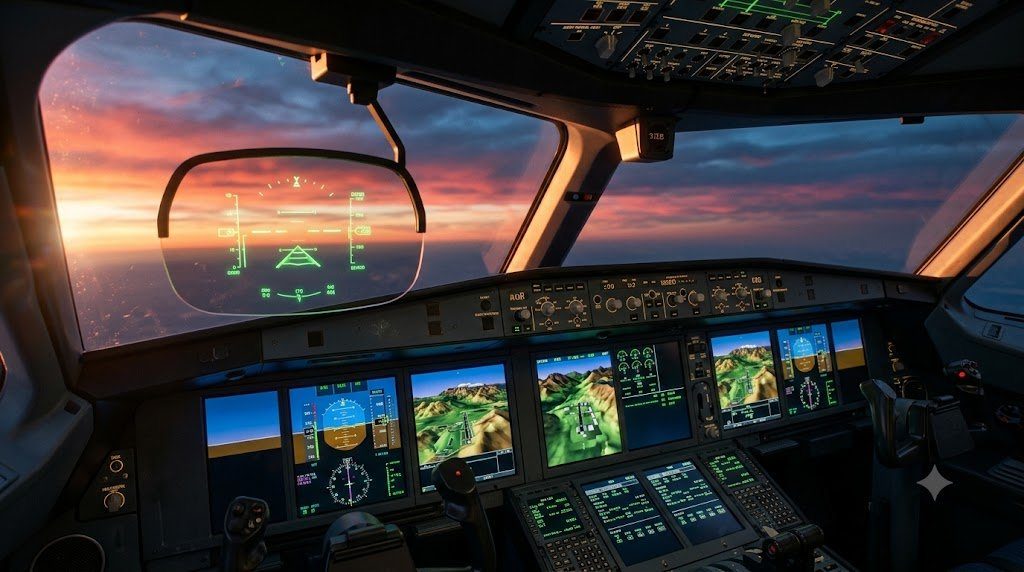
Welcome to AeroTechBase.online (accessible at https://aerotechbase.online/), an independent digital aerospace engineering archive, technical research repository, and pedagogical open-access publication committed to excellence in aircraft gas turbine propulsion, fly-by-wire flight control systems, advanced composite aerostructures, integrated modular avionics, and next-generation airport air traffic technology. Established to serve as a rigorous, mathematically sound bridge between academic aerospace engineering literature and frontline commercial aviation maintenance reality, AeroTechBase.online provides aeronautical engineers, flight test specialists, certified airframe and powerplant (A&P) technicians, and aerospace scholars with comprehensive technical monographs, empirical formulations, and verified aerodynamic methodologies.
AeroTechBase.online was founded upon an uncompromising aeronautical principle: that in atmospheric flight, physical laws govern without margin for error. From the Navier-Stokes equations governing transonic shockwave boundary-layer separation across supercritical wing aerofoils to Brayton thermodynamic cycles in high-bypass turbofans, deterministic ARINC 429 avionics bus telemetry, and fracture mechanics in carbon-fiber composite wing spars, flight safety demands deep conceptual literacy. We dedicate our research to providing peer-level technical documentation free from corporate marketing rhetoric or superficial summaries.
Editorial Leadership & Aeronautical Authority
AeroTechBase.online is curated and led by Dr. Adrian Vance, a veteran Aerospace Propulsion Engineer, Flight Dynamics Researcher, and certified aeronautical systems consultant with over 20 years of continuous research experience in gas turbine aerothermodynamics, fly-by-wire flight control laws, and high-altitude aeroelastic flutter. Having earned his Ph.D. in Aerospace Engineering with a doctoral dissertation evaluating high-pressure turbine blade film-cooling hydrodynamics under extreme thermal gradients, Dr. Vance has served as a senior technical consultant for commercial transport airframe manufacturers, defense propulsion contractors, and FAA/EASA airworthiness working groups.
Under Dr. Vance’s technical direction, every technical monograph, system schematic, aerodynamic derivation, and component specification table published on AeroTechBase.online undergoes exhaustive multi-tiered technical validation. Our editorial board cross-references all theoretical treatments against standardized international aerospace codes—principally the Federal Aviation Administration (FAA 14 CFR Part 25), the European Union Aviation Safety Agency (EASA CS-25), the International Civil Aviation Organization (ICAO), the Aeronautical Radio, Incorporated (ARINC), and RTCA DO-178C / DO-254 standards. We reject superficial summaries and generic overviews; our commitment is to provide actionable engineering depth that can be directly applied to aircraft design, fleet maintenance, and flight operations engineering.
Core Research Domains & Aeronautical Disciplines
Our open-access publication repository is structured across five primary branches of modern aerospace engineering:
- Aircraft Engines & Propulsion: Deep aerothermodynamic evaluations of high-bypass turbofans, geared turbofan (GTF) planetaries, multi-stage axial compressor stall and surge aerodynamics, combustor liner cooling, single-crystal nickel superalloy high-pressure turbine blades, Full Authority Digital Engine Control (FADEC), and variable area exhaust nozzles.
- Flight Control Systems: Kinematic modeling of fly-by-wire (FBW) triple-redundant architectures, primary flight control surface electro-hydraulic actuators (EHA / EBHA), high-lift slat/flap kinematics, pneumatic engine bleed air environmental control systems (ECS), and C* flight control laws.
- Aeronautical Structures & Materials: Classical laminate theory in carbon-fiber reinforced polymers (CFRP), titanium alloy Ti-6Al-4V forging mechanics, aluminum-lithium skin alloys, structural aeroelastic flutter mitigation, fatigue damage tolerance, and lightning strike protection mesh integration.
- Integrated Avionics & Guidance: Electronic Flight Instrument System (EFIS) glass cockpits, deterministic ARINC 429 and ARINC 664 (AFDX) avionics networks, Traffic Alert and Collision Avoidance Systems (TCAS II version 7.1), weather radar X-band Doppler waveguides, and GPS/INS Kalman filter navigation.
- Airport Infrastructure & Air Traffic Management: Instrument Landing Systems (ILS Cat IIIb/IIIc), Microwave Landing Systems (MLS), runway surface friction tribology and hydroplaning dynamics, NextGen Automatic Dependent Surveillance-Broadcast (ADS-B Out), and automated baggage handling RFID logistics.
Pedagogical Methodology and First-Principles Aeronautical Philosophy
Aerospace engineering is both an analytical science and a high-stakes operational craft. When an aircraft encounters an inflight emergency or uncommanded control oscillation, the root cause is rarely an inability to consult an electronic flight bag; rather, it is almost invariably a failure to anticipate fundamental physical behaviors: transonic shockwave migration across a swept wing causing Mach tuck, acoustic standing waves inducing combustor rumble, hydraulic fluid thermal expansion seizing flight control servo valves, or electromagnetic interference corrupting digital avionics bus arbitration. Our monographs emphasize first-principles thinking:
- First-Principles Mathematical Derivations: Every fundamental equation—from compressible isentropic gas flow relations across convergent-divergent nozzles to aeroelastic wing divergence speeds—is derived with clear physical context so engineers understand underlying assumptions and boundary limits.
- Empirical Manufacturing Context: Real-world commercial transport aircraft operate across extreme operational envelopes: from sea-level scorching desert heat (+50°C) to cruising altitudes at 41,000 feet where ambient temperatures plunge to -56.5°C and atmospheric pressure drops to 18 kPa. We integrate practical manufacturing tolerances, cold-expansion fastener hole techniques, shot peening residual stresses, and sealant hermeticity.
- Dynamic Failure Mode Diagnostics: We investigate real-world failure modes including compressor blade foreign object damage (FOD), turbine blade creep rupture, composite delamination under low-velocity impact, hydraulic cavitation in ram air turbines (RAT), and runaway trim stabilizer faults, offering prescriptive engineering countermeasures.
Bridging Aerodynamics with Modern Digital Flight Controls
In contemporary commercial transport aircraft (such as Airbus A350, Boeing 787, and modern bizjets), aerodynamic surfaces are completely slaved to high-speed digital flight control computers. An unstable or aerodynamically degraded aircraft cannot be manually hand-flown without computerized stability augmentation; conversely, computerized control laws must respect real aerodynamic stall margins and wing structural load limits.
At AeroTechBase.online, our research monographs specifically explore this aero-digital interface. We demonstrate how digital flight computers execute envelope protection to prevent aerodynamic stalls, how yaw dampers suppress Dutch roll oscillations, and how active load alleviation systems deflect ailerons dynamically during atmospheric turbulence gusts to reduce wing-root bending fatigue. By uniting aerodynamics with digital flight control engineering, we empower aeronautical practitioners to conquer modern flight complexity.
Institutional Commitments, Editorial Independence & Open Standards
AeroTechBase.online is maintained as an independent technical resource. We do not accept sponsored content, paid promotional vendor placements, or deceptive commercial endorsements. When computational algorithms, numerical formulas, airframe alloys, or flight simulation models are cited, they are chosen solely for their technical merit, educational value, and verifiable reliability. Our operational costs are supported via transparent digital advertising networks, including Google AdSense, which are strictly segregated from our technical editorial decisions.
We welcome peer review, collaborative academic inquiries, and field data exchange from practicing aeronautical engineers, flight test pilots, and certified technicians worldwide. Aerospace engineering thrives when ideas are tested, challenged, and refined through physical verification. Thank you for visiting AeroTechBase.online, and we invite you to explore our comprehensive library of aerospace monographs.