AEROSPACE ENGINEERING / AIRCRAFT STRUCTURES
The Engineering Behind Flexible Aircraft Wings
Discover why aircraft wings bend during flight, how structural materials carry enormous forces, and why controlled flexibility is an important part of modern aircraft design.
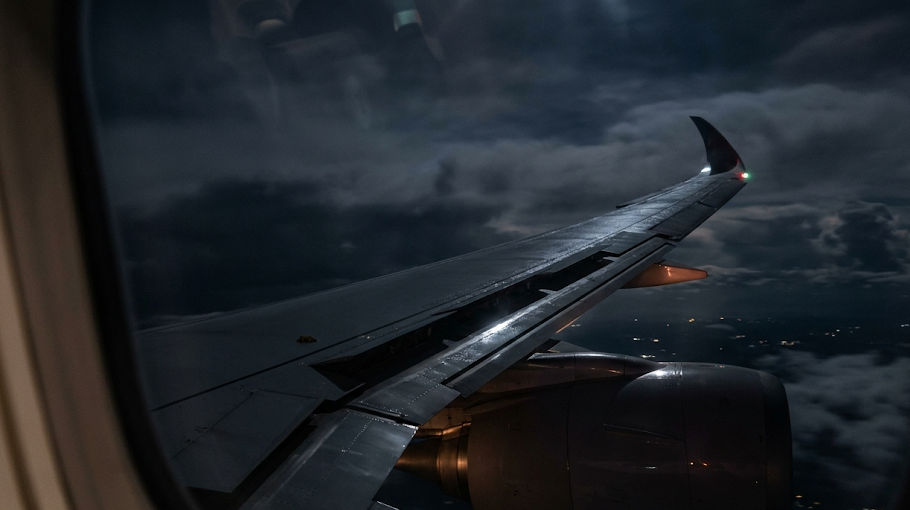
Look out of an airplane window during takeoff or while flying through turbulence, and you may notice the wing moving slightly up and down.
On some aircraft, the wingtips can move by a surprisingly large amount.
To passengers, this movement may look unusual or even concerning.
However, aircraft wings are designed to flex under normal flight loads.
Wing flexibility is not automatically a sign of weakness. It is a controlled structural response to aerodynamic forces.
Modern aircraft wings must support the aircraft, withstand changing air loads, carry fuel and engines on many designs, and remain reliable through repeated flights.
To accomplish this, engineers carefully balance strength, stiffness, weight, fatigue resistance, and aerodynamic performance.
Understanding why wings flex reveals how materials science and structural engineering make modern aviation possible.
Why Do Aircraft Wings Bend During Flight?
Aircraft wings generate lift as air flows around their surfaces.
Lift is distributed along the wing rather than acting at only one point.
These aerodynamic forces create bending moments that tend to deflect the wings upward during many normal flight conditions.
The wing structure resists these loads, but it is not perfectly rigid.
As a result, the wing bends slightly while remaining within its intended operating limits.
The amount of movement depends on the aircraft design, wing length, material properties, flight speed, aircraft weight, and atmospheric conditions.
Long, slender wings may show more visible deflection than shorter, stiffer designs.
Engineers calculate these movements during development and verify structural behavior through analysis and testing.
How Lift Creates Bending Forces
During flight, aerodynamic pressure differences and airflow direction changes create lift on the wings.
For an aircraft in steady, level flight, total lift approximately balances the aircraft’s weight.
However, the loads are distributed differently across the aircraft structure.
The wings generate much of the lift, while the fuselage, fuel, passengers, cargo, and other components contribute to the overall weight distribution.
This creates bending forces along the wings.
Engineers describe the resulting structural effect using the concept of a bending moment.
The bending moment is often greatest near the wing root, where the wing connects to the fuselage.
This region must transfer substantial forces into the aircraft’s main structure.
STRUCTURAL ENGINEERING / LOAD PATH
Aerodynamic Lift → Wing Bending → Structural Load Transfer → Fuselage
The wing structure carries distributed aerodynamic forces and transfers them through spars, ribs, skins, and attachment structures.
Why Wings Are Designed to Flex Instead of Staying Completely Rigid
A perfectly rigid wing would require an extremely stiff structure.
Achieving that stiffness could add substantial weight.
Additional structural weight increases the amount of lift required and can reduce aircraft efficiency.
Aircraft designers therefore aim for sufficient stiffness and strength rather than absolute rigidity.
Controlled flexibility allows the structure to deform elastically under expected loads.
Elastic deformation means the material returns toward its original shape when the load is removed.
However, flexibility must remain within carefully defined limits.
Excessive deformation can affect aerodynamic performance, control behavior, and structural integrity.
The goal is a balanced design that safely handles loads without unnecessary weight.
The Main Structural Parts of an Aircraft Wing
An aircraft wing is not simply a thin outer shell.
Inside it is a carefully engineered framework that distributes and resists loads.
Wing Spars
Spars are major structural members that extend along the wing.
They carry significant bending and shear loads.
Many wings use front and rear spars as part of a larger structural arrangement.
Wing Ribs
Ribs help maintain the wing’s aerodynamic shape and distribute loads between structural components.
They also support the outer skin and internal systems.
Wing Skin
The outer skin provides a smooth aerodynamic surface.
In many aircraft, it also carries structural loads as part of a stressed-skin design.
Wing Box
The wing box is a major load-carrying structure formed by spars, skins, and supporting members.
It helps resist bending and twisting forces.
In many transport aircraft, portions of the wing box also form fuel tank boundaries.
How Aluminum Wings Handle Flight Loads
Aluminum alloys have been widely used in aircraft structures because they offer a useful balance of strength, weight, manufacturability, and cost.
Aircraft-grade aluminum structures can deform elastically under normal operating loads.
Engineers select alloys and structural arrangements according to strength, fatigue resistance, corrosion behavior, and manufacturing requirements.
Metal wings may include machined components, riveted joints, stiffeners, and reinforced attachment regions.
The structure is designed so that loads are distributed through multiple components rather than concentrated in one small area.
Careful inspection and maintenance are important because repeated loading can eventually produce fatigue damage.
Why Modern Aircraft Use Composite Materials
Many newer aircraft use carbon-fiber-reinforced polymer composites in major structural components.
These materials combine strong carbon fibers with a polymer matrix.
Composite structures can provide high strength and stiffness relative to their weight.
They also allow engineers to tailor material properties by controlling fiber orientation.
For example, fibers can be arranged to resist expected loads in particular directions.
This flexibility in material design can help create efficient wing structures.
However, composite materials also introduce challenges involving impact damage, inspection, repair, and manufacturing quality.
Composite wings are not automatically more flexible than metal wings in every situation.
The final stiffness depends on the complete structural design, not simply the material category.
| Property | Aluminum Alloys | Carbon-Fiber Composites |
|---|---|---|
| Weight Efficiency | Good | Potentially excellent |
| Material Directionality | Often approximately uniform in different directions | Properties can be tailored by fiber orientation |
| Manufacturing | Well-established metalworking methods | Specialized composite manufacturing processes |
| Damage Concerns | Fatigue cracking and corrosion | Impact damage and delamination |
| Design Flexibility | Controlled through geometry and alloy selection | Controlled through geometry and fiber layup |
What Happens to Wings During Turbulence?
Turbulence causes changes in airflow around an aircraft.
These changes can produce temporary variations in aerodynamic loads.
As the loads change, the wings may bend upward or downward relative to their previous position.
This movement is part of the wing’s structural response.
Aircraft are designed and tested to withstand specified gust and maneuver loads.
However, turbulence can still be uncomfortable and may cause injuries to unrestrained passengers.
Passengers should keep their seat belts fastened whenever seated, even when the seat belt sign is off.
Visible wing movement during turbulence does not automatically indicate structural damage.
How Engineers Measure Wing Loads
Aircraft engineers use load factors to describe how aerodynamic and inertial forces compare with the aircraft’s weight.
A load factor of 1g corresponds approximately to the normal support force experienced during steady, level flight.
During certain maneuvers or gusts, the load factor can increase or decrease.
Higher positive load factors generally increase upward wing bending loads.
Aircraft certification standards define structural load requirements for different aircraft categories.
Designers evaluate both limit loads and ultimate loads.
Limit loads represent specified maximum loads expected under defined operating conditions.
Ultimate loads include an additional safety factor.
For many transport-aircraft structural requirements, the ultimate-load factor is 1.5 times the applicable limit load, although specific rules and exceptions apply.
The structure must demonstrate compliance with the relevant certification requirements.
How Aircraft Wings Are Tested Before Entering Service
Aircraft manufacturers conduct extensive structural testing during development and certification.
One important method is static load testing.
In these tests, controlled forces are applied to the wing to simulate demanding flight conditions.
Engineers measure deflection, strain, and structural behavior.
Large test rigs may use hydraulic actuators to apply loads at multiple locations.
The wing may bend dramatically during these tests.
Such movement is expected when testing a structure designed to carry large distributed loads.
Manufacturers also perform fatigue testing to study the effects of repeated loading over time.
These tests help identify potential durability concerns before aircraft enter service.
AIRCRAFT CERTIFICATION / STRUCTURAL TESTING
Engineers Test Wings Beyond Ordinary Flight Conditions.
Static and fatigue testing help verify that aircraft structures can withstand required loads and repeated service conditions.
Why Long Wings Often Show More Flex
Long wings create greater leverage between aerodynamic forces and the wing root.
This can produce substantial bending moments.
Long, slender wings are often used because they can improve aerodynamic efficiency by reducing induced drag.
However, their structural design must account for bending, twisting, vibration, and weight.
Engineers may use carefully selected materials, internal reinforcement, and optimized wing geometry to manage these loads.
The amount of visible flex is therefore a result of both aerodynamic and structural design choices.
More visible movement does not necessarily mean a wing is less safe.
Can Wing Flex Improve Aerodynamic Efficiency?
Wing flexibility can influence aerodynamic performance because bending and twisting change the wing’s shape during flight.
In some designs, engineers use aeroelastic behavior to achieve favorable load distributions.
This can help reduce structural weight or improve performance under particular conditions.
However, uncontrolled deformation can create serious problems.
Aircraft designers must prevent harmful aeroelastic effects such as flutter.
Flutter is a dynamic instability involving interactions between aerodynamic forces, structural flexibility, and inertia.
It is not the same as ordinary wing bending.
Flutter can be dangerous, so aircraft undergo extensive analysis and testing to demonstrate adequate margins against it.
What Is Metal Fatigue and Why Does It Matter?
Aircraft structures experience repeated loading during takeoff, landing, turbulence, and normal flight operations.
Over time, repeated stress cycles can contribute to fatigue damage in susceptible materials and structural details.
Fatigue cracks may begin at locations where stress is concentrated.
Engineers address this risk through material selection, structural design, testing, inspection programs, and maintenance requirements.
Composite structures also require durability assessment, although their damage mechanisms differ from those of metals.
Modern aircraft maintenance programs include procedures intended to detect and manage structural deterioration before it becomes unsafe.
Do Wings Flex More During Takeoff or Landing?
Wing deflection changes with aerodynamic loading, aircraft weight, fuel distribution, and flight conditions.
During takeoff, increasing lift can cause the wings to bend upward as the aircraft becomes airborne.
During landing, changing lift and ground-support conditions alter the wing’s load distribution.
When an aircraft is parked, the wings may have a different shape because aerodynamic lift is absent.
Fuel stored in the wings and engines mounted beneath them also affect structural loading.
The visible movement depends on the specific aircraft design.
There is no universal rule that every aircraft wing bends most during one particular phase of flight.
Common Misconceptions About Wing Flex
AEROSPACE ENGINEERING / MYTHS & FACTS
Myth: Aircraft wings should remain completely rigid.
Fact: Controlled elastic deformation is a normal part of aircraft structural behavior.
Myth: A wing that bends visibly is about to break.
Fact: Visible deflection can occur within the aircraft’s intended operating limits.
Myth: Composite wings are always more flexible than metal wings.
Fact: Flexibility depends on structural geometry, material properties, and design.
Myth: Turbulence automatically damages aircraft wings.
Fact: Aircraft are designed for specified gust loads, although severe conditions require appropriate operational precautions.
Myth: More wing flex always improves efficiency.
Fact: Excessive deformation can reduce performance or create aeroelastic risks.
Frequently Asked Questions
Why do airplane wings move up and down?
Wings flex in response to changing aerodynamic loads, including lift variations caused by maneuvers and turbulence.
Is it safe for aircraft wings to bend?
Yes, controlled wing flex is an expected part of aircraft operation. Aircraft structures are designed and tested to meet applicable safety requirements.
What materials are used in modern aircraft wings?
Common materials include aluminum alloys and carbon-fiber-reinforced composites, along with other structural materials selected for specific applications.
Why do long wings bend more visibly?
Long wings can experience substantial bending moments because aerodynamic forces act over greater distances from the wing root.
Can wing flex cause structural failure?
Uncontrolled deformation and aeroelastic instability can be dangerous, which is why aircraft structures undergo extensive analysis, testing, and certification.
Do aircraft wings return to their original shape?
Under normal elastic loading, wings return toward their unloaded shape when the applied forces decrease.
Final Thoughts
Aircraft wings flex because they must carry large and changing aerodynamic loads while remaining lightweight and efficient.
The bending seen during flight is usually a normal response of the wing structure.
Engineers use spars, ribs, stressed skins, wing boxes, and carefully selected materials to distribute and resist these forces.
Modern aluminum and composite structures are designed to provide the necessary combination of strength, stiffness, and durability.
Aircraft manufacturers verify structural performance through calculations, simulations, static tests, and fatigue testing.
Wing flexibility must also be controlled to prevent excessive deformation and dangerous aeroelastic effects.
The result is a carefully balanced structure capable of supporting the aircraft through changing flight conditions.
The next time you notice an aircraft wing moving during flight, remember that controlled flexibility is part of the engineering that allows modern airplanes to fly safely and efficiently.