AVIATION ENGINEERING / AIRCRAFT PROPULSION
Two Engine Designs. Two Very Different Flying Missions.
Explore how turbofan and turboprop engines generate thrust, why their efficiency changes with speed, and how aircraft manufacturers choose the right propulsion system.
Watch aircraft departing a busy airport, and you may notice two very different engine designs. Large passenger jets usually have rounded engine nacelles beneath their wings, while many smaller regional aircraft use engines connected to visible propellers.
These differences are not simply matters of appearance. They reflect the different ways aircraft generate thrust and the operating conditions for which they are designed.
Modern commercial jets commonly use turbofan engines, while many regional, utility, and specialized aircraft rely on turboprop engines.
Both systems are based on gas-turbine technology, but they use the energy produced by combustion in different ways. Understanding their operation helps explain why one aircraft is optimized for fast, high-altitude travel while another performs efficiently on shorter routes.
What Is a Turbofan Engine?
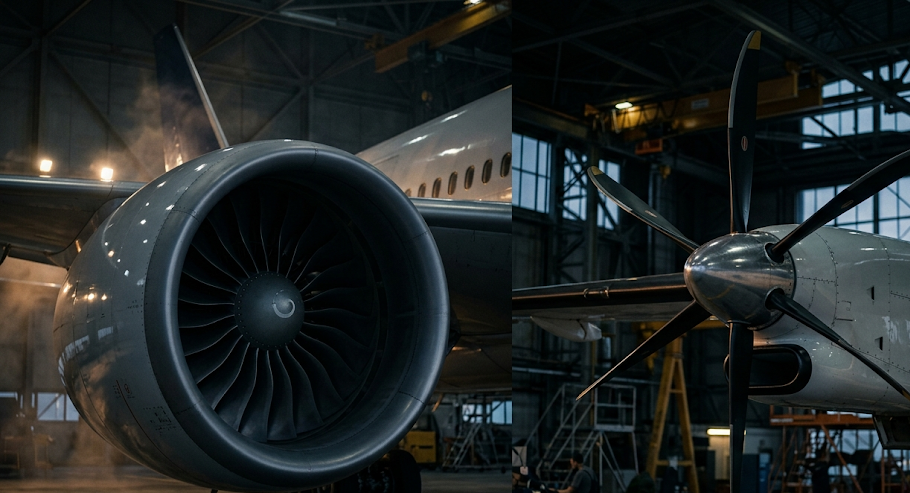
A turbofan is a type of gas-turbine engine that uses a large fan at the front to move air through and around the engine core.
Air entering the engine is divided into two main streams. Some passes through the core, where it is compressed, mixed with fuel, and involved in combustion. The remaining air flows around the core through a bypass duct.
Hot gases leaving the combustion chamber expand through turbines, which provide the mechanical power needed to drive the compressor and fan.
The engine generates thrust by accelerating air backward. In modern high-bypass turbofans, the bypass airflow contributes a large share of total thrust.
This arrangement makes turbofans well suited to many passenger aircraft that travel at relatively high subsonic speeds.
What Is a Turboprop Engine?
A turboprop is also a gas-turbine engine, but most of its useful output is delivered as mechanical power to a propeller.
Air enters the engine core and passes through a compressor, combustion chamber, and turbine stages. The turbines extract energy from the hot gases to drive the compressor and propeller system.
Because gas turbines typically operate at much higher rotational speeds than propellers, a reduction gearbox is generally used to lower the propeller’s speed.
The propeller produces most of the aircraft’s thrust by accelerating a large mass of air backward.
Turboprops are particularly effective at the moderate speeds commonly used by regional aircraft, cargo planes, and certain specialized aviation operations.
PROPULSION SYSTEM 01
Turbofan
Uses a ducted fan and gas-turbine core to generate thrust, making it well suited to faster commercial aircraft.
PROPULSION SYSTEM 02
Turboprop
Uses a gas turbine to drive an external propeller, providing efficient thrust at moderate flight speeds.
The Science Behind Aircraft Thrust
Both turbofans and turboprops produce thrust by accelerating air in the opposite direction of aircraft movement.
This follows Newton’s third law of motion: when the propulsion system pushes air backward, the air exerts an opposing force that helps move the aircraft forward.
The two engine types differ mainly in how they accelerate that air.
A turboprop uses a relatively large external propeller to move substantial quantities of air. A turbofan uses a ducted fan and engine exhaust to produce thrust.
In general, accelerating a larger mass of air by a smaller amount can be an efficient way to generate thrust at subsonic speeds.
However, the best design depends on flight speed, altitude, aircraft size, installation requirements, and other engineering constraints.
FLIGHT PHYSICS / SHARED PRINCIPLE
Air Accelerated Backward
↓
Forward Thrust on the Aircraft
Both propulsion systems follow the same fundamental momentum principle.
Why Turboprops Work Well at Lower Speeds
Turboprops are often highly efficient at moderate flight speeds because their propellers move large amounts of air without requiring extremely high exhaust velocities.
At these speeds, propellers can provide excellent propulsive efficiency.
However, propeller performance becomes more challenging as aircraft speed increases. The rotating blade tips move faster than the aircraft itself, and their local airflow can approach transonic conditions.
Compressibility effects, drag increases, and noise can limit the practical efficiency of conventional propeller systems at higher speeds.
Modern propeller designs use carefully shaped blades and controlled rotational speeds to improve performance, but turboprops are still generally associated with slower cruise speeds than typical jet airliners.
Why Turbofans Dominate High-Speed Passenger Travel
Commercial airlines often prioritize cruising speed, passenger capacity, and the ability to operate efficiently over long distances.
High-bypass turbofan engines are particularly well suited to these requirements.
Their ducted fans and engine cores are optimized for efficient operation at the high subsonic speeds typical of modern airliners.
Turbofan-powered aircraft can also operate at high cruising altitudes where lower air density reduces aerodynamic drag.
This combination supports relatively fast travel while maintaining favorable fuel efficiency for the aircraft’s intended mission.
However, turbofans are not automatically more efficient than turboprops on every route. On short sectors, the benefits of higher cruising speed may be reduced by the proportion of time spent climbing, descending, and taxiing.
Turbofan vs Turboprop: Speed and Altitude
Aircraft powered by turbofans generally cruise faster than comparable turboprop aircraft.
Many commercial jet airliners cruise around Mach 0.75 to Mach 0.85, although actual speeds vary with aircraft type and operating conditions.
Regional turboprops typically cruise at lower speeds, often in the general range of 250 to 400 miles per hour.
Jet airliners also commonly operate at higher cruising altitudes than many regional turboprop aircraft.
These differences reflect overall aircraft design, not engine technology alone. Wing configuration, structural limits, pressurization systems, and operational requirements also influence performance.
Which Engine Uses Less Fuel?
Fuel efficiency comparisons must account for aircraft size, passenger load, flight distance, speed, and operating conditions.
On many short regional routes, turboprop aircraft can consume less fuel than similarly sized regional jets because they are optimized for lower-speed operation.
However, a large modern turbofan-powered airliner may achieve excellent fuel consumption per passenger over longer routes.
Comparing fuel burned per hour without considering passenger capacity or distance traveled can therefore be misleading.
A fair comparison may use fuel consumption per passenger-mile or per seat-mile under comparable operating conditions.
Even then, results depend on aircraft loading, weather, route structure, and the specific engine models involved.
Turbofan vs Turboprop Comparison Table
| Feature | Turbofan Engine | Turboprop Engine |
|---|---|---|
| Main Thrust Source | Ducted fan and exhaust | External propeller |
| Typical Cruise Speed | Higher | Lower |
| Common Aircraft | Commercial jets and business jets | Regional, utility, and cargo aircraft |
| Short-Route Efficiency | Depends on aircraft and mission | Often advantageous |
| Long-Range High-Speed Travel | Well suited | Usually less suitable |
| Propulsion Hardware | Large ducted fan | External propeller and gearbox |
Why Turboprops Are Popular for Regional Flights
Regional airlines often connect smaller cities with larger transportation hubs. These routes may be too short for a jet’s speed advantage to make a substantial difference in total travel time.
Turboprop aircraft can be attractive because they are designed for efficient operation at moderate speeds and may offer favorable operating economics on shorter routes.
Some turboprop aircraft can also operate from relatively short runways, although actual runway requirements depend on aircraft weight, weather, airport elevation, and other factors.
These capabilities make turboprops useful for airports with limited infrastructure.
However, route economics depend on much more than engine type. Passenger demand, aircraft utilization, maintenance, airport charges, and scheduling requirements all influence airline decisions.
Why Long-Distance Aircraft Usually Use Turbofans
Long-distance passenger aircraft need to carry substantial loads while maintaining high cruising speeds for many hours.
Turbofans are well suited to this mission because they combine strong thrust capability with efficient high-subsonic operation.
Large modern airliners use carefully optimized engine and wing combinations to reduce fuel consumption over long distances.
High-altitude cruising also helps aircraft avoid some weather conditions and operate in lower-density air, although flight levels are selected based on multiple operational considerations.
For passengers, the higher speed of turbofan aircraft can significantly reduce travel time on longer routes.
Are Turboprops Less Safe Than Jets?
Engine type alone does not determine aircraft safety.
Both turbofan and turboprop aircraft can meet demanding certification standards and operate safely when properly maintained and flown within their approved limits.
Aircraft safety depends on design, maintenance, pilot training, operational procedures, weather conditions, and regulatory oversight.
Turboprop aircraft may encounter more noticeable vibration or noise in certain cabin locations, but those characteristics should not be confused with reduced safety.
Passengers should evaluate an airline’s safety practices rather than assuming that visible propellers indicate an outdated or unsafe aircraft.
Maintenance and Operating Costs
Both propulsion systems require specialized maintenance because their turbine components operate at high temperatures and rotational speeds.
Turbofan engines include complex fan, compressor, combustion, and turbine systems. Turboprops add propeller assemblies and reduction gearboxes that require inspection and servicing.
Maintenance costs vary considerably between specific engine models and aircraft applications.
Aircraft operators also consider fuel prices, engine overhaul intervals, spare-parts availability, reliability, and downtime.
It is therefore inaccurate to assume that turboprops are always cheaper to maintain or that turbofans are inherently more expensive in every situation.
The Future of Turbofan and Turboprop Technology
Aircraft manufacturers and engine developers continue exploring ways to improve efficiency and reduce environmental impacts.
New turbofan designs may incorporate advanced materials, improved aerodynamics, and geared fan systems that allow different components to operate at more favorable speeds.
Turboprop development includes improved propeller blade designs, electronic engine controls, and more efficient turbine technology.
Researchers are also investigating open-fan propulsion concepts that combine features associated with propeller and turbofan systems.
Hybrid-electric propulsion and alternative fuels may influence future aircraft designs, although their practical applications depend on technical and economic progress.
The long-term goal is to match propulsion technology more closely to aircraft missions while improving efficiency and reducing emissions.
Frequently Asked Questions
What is the main difference between turbofan and turboprop engines?
A turbofan generates thrust using a ducted fan and exhaust, while a turboprop uses a gas turbine to drive an external propeller.
Which engine is more fuel-efficient?
Turboprops often have an advantage on shorter, slower routes. Turbofans are generally better suited to efficient high-speed travel over longer distances.
Are turboprops slower than jets?
Most regional turboprop aircraft cruise more slowly than modern turbofan-powered passenger jets.
Do turboprops use jet engines?
Yes. A turboprop uses a gas-turbine core, but most of its useful power drives a propeller rather than producing direct exhaust thrust.
Why do some airlines still use propeller aircraft?
Turboprops can offer favorable economics and operational flexibility on shorter regional routes.
Are turbofan engines quieter?
Cabin noise depends on aircraft design, engine installation, insulation, and seating position. Engine type alone does not determine the passenger experience.
Can turboprop aircraft fly at high altitudes?
Yes. Many turboprops are capable of high-altitude flight, although their typical operating altitudes are often lower than those of large jet airliners.
Final Thoughts
Turbofan and turboprop engines share the same basic gas-turbine principles, but their propulsion systems are optimized for different operating conditions.
Turbofans are particularly effective for faster aircraft operating at high subsonic speeds, making them the preferred choice for most modern passenger jets.
Turboprops use external propellers to produce efficient thrust at moderate speeds, which makes them valuable for regional routes and specialized operations.
Neither engine type is universally better. Aircraft manufacturers choose propulsion systems by balancing speed, fuel consumption, range, payload, airport requirements, and operating costs.
The next time you see a jet airliner beside a propeller-driven regional aircraft, remember that both represent carefully engineered solutions to different transportation challenges.