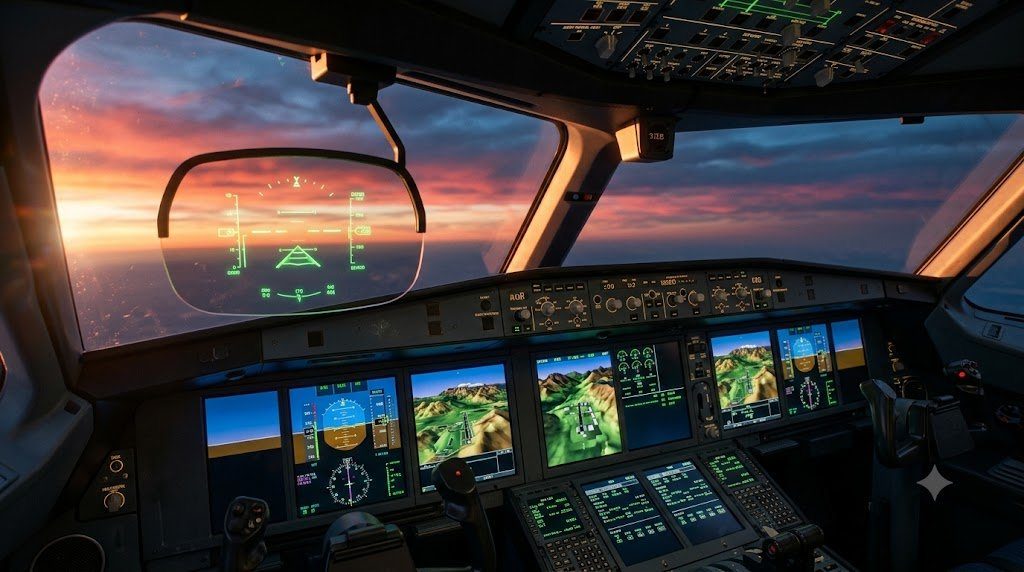
How an Aircraft’s Glass Cockpit Turns Sensor Data into Flight Information

AVIONICS FLIGHT DECK REVIEW / AVIATION TECHNOLOGY From Invisible Measurements to a Clear Flight Picture Discover how aircraft sensors, computers, and electronic displays work together to help pilots understand speed, altitude, attitude, navigation, and aircraft systems. FLIGHT SENSORS AVIONICS COMPUTERS DIGITAL DISPLAYS Step inside the cockpit of a modern aircraft, and you may notice something … Read more

TCAS II Collision Avoidance: Mode S Interrogation, Tau Closure Calculations and Coordinated Resolution Advisories

In the high-density airspace environments traversed by commercial aviation, mid-air collisions represent catastrophic, zero-survivability events. To provide an autonomous, air-to-air safety net completely independent of ground air traffic control (ATC) radar, international civil aviation mandates the operation of the Traffic Alert and Collision Avoidance System (TCAS II Version 7.1). Interrogating neighboring aircraft transponders at 1,030 … Read more

Glass Cockpits and Integrated EFIS: Primary Flight Displays, Head-Up Displays and Synthetic Vision Systems

The flight deck environment of commercial transport and advanced military aircraft has migrated completely from the electro-mechanical clutter of legacy analog dial instruments (’round dials’) toward fully integrated Electronic Flight Instrument Systems (EFIS / Glass Cockpits). Presenting dynamic flight symbology across high-resolution active-matrix liquid crystal displays (AMLCD) and organic light-emitting diode (OLED) screens, modern flight … Read more

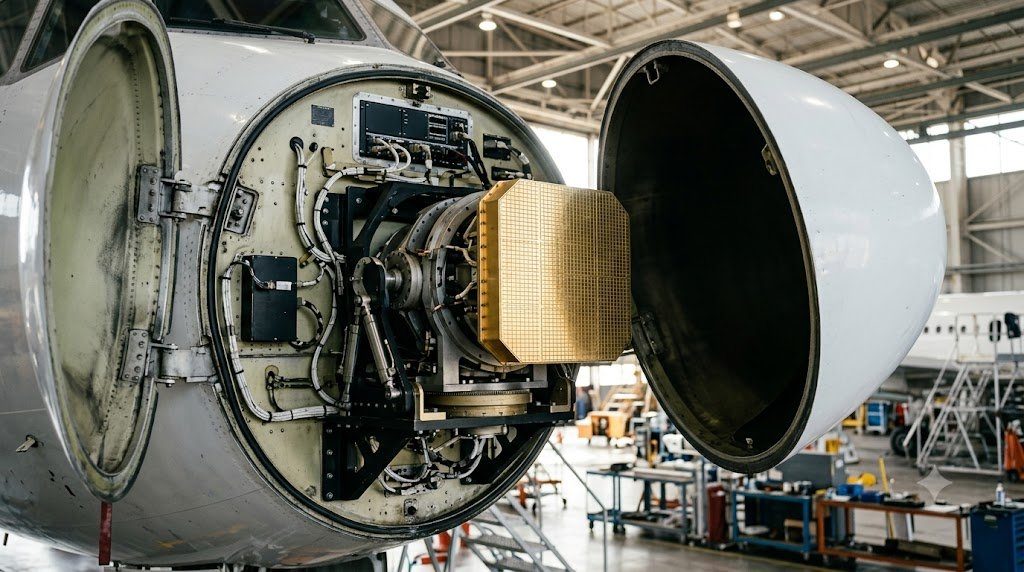
Airborne Weather Radar: X-Band Magnetrons, Slotted Planar Arrays and Predictive Windshear Detection

Navigating commercial air transports through active convective weather systems, violent thunderstorms, supercells, and nocturnal squall lines demands real-time meteorological intelligence. Positioned inside the radar-transparent dielectric radome on the aircraft nose, the Airborne Weather Radar System provides flight crews with high-resolution reflectivity mapping of precipitation cores, hail shafts, and catastrophic low-altitude convective microbursts via advanced Pulse-Doppler … Read more

ARINC 429 Avionics Data Bus: Bipolar Return-to-Zero Signaling, Word Framing and Protocol Troubleshooting

In the digital electronics architecture of modern civil transport aircraft, reliable, deterministic data exchange between flight computers, navigation receivers, air data inertial reference units, and electronic flight displays is life-critical. Established by the Airlines Electronic Engineering Committee (AEEC) and published by Aeronautical Radio, Incorporated in the late 1970s, the ARINC 429 Digital Information Transfer System … Read more