In the high-density airspace environments traversed by commercial aviation, mid-air collisions represent catastrophic, zero-survivability events. To provide an autonomous, air-to-air safety net completely independent of ground air traffic control (ATC) radar, international civil aviation mandates the operation of the Traffic Alert and Collision Avoidance System (TCAS II Version 7.1). Interrogating neighboring aircraft transponders at 1,030 MHz and tracking replies at 1,090 MHz, TCAS II calculates three-dimensional closing trajectories, evaluates collision time thresholds ($\tau$), and issues synchronized vertical Resolution Advisories (RA) to pilots.
Traditional spatial separation models that trigger alarms based on fixed nautical mile distances fail at high jet closure rates: two supersonic fighters or head-on air transports closing at a relative speed of 1,000 knots cover one nautical mile in under 3.6 seconds. TCAS II evaluates collision hazard based on the temporal parameter Tau ($\tau = -R / \dot{R}$)—the instantaneous range ($R$) divided by closing range rate ($\dot{R}$). Alarms trigger strictly when time to closest point of approach drops beneath critical seconds, regardless of absolute physical distance.
Transponder Interrogation Protocols: Mode C vs. Mode S Selective Interrogation
TCAS II operates through active directional antenna arrays mounted on the top and bottom fuselage skin. The system interrogates transponders across two primary signaling modes:
- Mode C Interrogation (Legacy): Broadcasts an omnidirectional radio pulse to all aircraft within range, prompting them to reply with their pressure altitude (encoded in 100-foot Gray code increments). However, in dense airspace (over London or New York), simultaneous replies cause radio packet interference termed ‘Transponder Fruit’ and ‘Garble’.
- Mode S Selective Interrogation (Modern Standard): Mode S transponders broadcast spontaneous identity announcements—Acquisition Squitters—once per second containing their unique 24-bit ICAO aircraft address. Once TCAS II acquires this address, it interrogates that specific aircraft selectively using narrow directional antenna beams, eliminating radio interference across congested airspace.
The Two-Tiered Alert Hierarchy: Traffic Advisories vs. Resolution Advisories
When a closing intruder trajectory violates protected airspace boundaries, TCAS II escalates through a two-tiered alert hierarchy:
- Traffic Advisory (TA): Triggered when time to closest approach ($\tau$) drops beneath 35 to 48 seconds. TCAS synthesizes an acoustic warning (‘TRAFFIC, TRAFFIC’) and displays the intruder as an amber circle on the Navigation Display (ND). The TA prepares the flight crew visually, but does NOT command flight maneuvers.
- Resolution Advisory (RA): Triggered when $\tau$ drops beneath 20 to 35 seconds. TCAS escalates to emergency status, synthesizing urgent vocal flight commands (e.g., ‘CLIMB, CLIMB’ or ‘DESCEND, DESCEND’). The Electronic Attitude Director Indicator (EADI) illuminates green fly-to vertical speed tape regions while blocking red prohibited climb/descent zones, commanding a standard vertical rate of ±1,500 to ±2,000 feet per minute.
| TCAS Threat Level | Cockpit Display Symbol | Time to Impact (τ Threshold) | Acoustic Vocal Announcement | Pilot Operational Mandate |
|---|---|---|---|---|
| Non-Threat Traffic | Open Cyan / White Diamond | τ > 48 seconds / Distant | None (Visual Background) | Routine Situational Awareness |
| Proximity Traffic | Solid Cyan / White Diamond | Within ±6 NM and ±1,200 ft | None | Monitor Closely |
| Traffic Advisory (TA) | Solid Amber Circle | τ = 35 – 48 seconds | ‘TRAFFIC, TRAFFIC’ | Visual Search / Do NOT Maneuver |
| Resolution Advisory (RA) | Solid Red Square | τ = 20 – 35 seconds | ‘CLIMB, CLIMB’ / ‘DESCEND’ | MANDATORY PILOT RESPONSE within 5 sec |
Air-to-Air Coordinated Cross-Resolution Linkage via Mode S
The definitive safety feature of TCAS II is Autonomous Air-to-Air RA Coordination. If two aircraft on a collision course were both commanded to climb, a catastrophic mid-air collision would still occur. When TCAS II issues an RA, the two aircraft computers establish an immediate direct Mode S digital data link between airframes in microseconds.
The computers coordinate complementary, non-conflicting maneuvers: if Aircraft A elects to CLIMB, it transmits an air-to-air coordination message instructing Aircraft B’s TCAS to issue a complementary DESCEND advisory. This coordination operates with complete independence from ground air traffic controllers.
The Primacy of TCAS: The Überlingen Mid-Air Collision Lesson
In 2002, the tragic mid-air collision over Überlingen, Germany, occurred when an air traffic controller commanded a Russian passenger jet to descend while its TCAS II commanded it to climb (the opposing aircraft’s TCAS commanded it to descend). The Russian crew followed the human controller rather than TCAS, resulting in a fatal mid-air collision.
In response, international aviation law (ICAO Annex 2 and FAA regulations) was amended to mandate that TCAS Resolution Advisories have absolute legal primacy over ground ATC instructions. When an RA sounds, pilots must disconnect the autopilot and follow the TCAS flight director immediately, regardless of conflicting instructions from air traffic control.
Tau Collision Geometry, Mode S Interrogation Protocols and Coordinated Maneuver Logic
The Traffic Alert and Collision Avoidance System (TCAS II Version 7.1) operates as an autonomous airborne collision safeguard, independent of ground-based Air Traffic Control (ATC). TCAS II functions by actively transmitting Mode C and Mode S interrogations on $1030 \text{ MHz}$ and listening for transponder replies from nearby aircraft on $1090 \text{ MHz}$. Instead of calculating spatial separation distance alone, the foundational mathematical logic governing TCAS collision avoidance is parameterized by Tau ($\tau$)—the estimated Time-to-Closest-Approach (CPA):
τ = – r / ṙ = – (Range) / (Range Rate) ≤ τthreshold
Because high-speed head-on encounters occur at closure rates ($\dot{r}$) exceeding 1,000 knots (514 m/s), fixed spatial distance thresholds are inadequate. When range closure rate indicates that $\tau$ has dropped beneath warning thresholds (typically 35 to 48 seconds at cruise altitudes) and altitude separation is projected to drop beneath critical margins, the system issues a Traffic Advisory (TA) (‘TRAFFIC, TRAFFIC’). If closure continues and $\tau$ decreases below 20 to 35 seconds, TCAS issues a Resolution Advisory (RA) (‘CLIMB, CLIMB’ or ‘DESCEND, DESCEND’), commanding vertical evasive maneuvers.
When two TCAS-equipped aircraft encounter a mutual collision geometry, their onboard Mode S transponders execute high-speed cross-link coordination over 1030/1090 MHz. TCAS algorithms prevent identical maneuvers (both climbing or both descending) by negotiating complementary Resolution Advisories via Mode S Comm-A/Comm-B data packets. If Aircraft A issues a ‘CLIMB’ RA, its transponder commands Aircraft B to issue a complementary ‘DESCEND’ RA within 100 milliseconds, guaranteeing diverging flight trajectories.
TCAS II Version 7.1 Reversal Logic and ‘LEVEL OFF’ Maneuver Mechanics
Following lessons learned from the 2002 Überlingen mid-air collision, TCAS Version 7.1 introduced critical safety enhancements: (1) Reversal RA Logic dynamically detects if an intruder aircraft is failing to comply with its own RA or maneuvering in direct opposition, automatically flipping the local RA (e.g., reversing from ‘CLIMB’ to ‘DESCEND, NOW DESCEND’); and (2) ‘LEVEL OFF, LEVEL OFF’ commands replace ‘Adjust Vertical Speed’ commands to prevent pilots from aggressive over-climbing, guiding vertical speed smoothly to zero feet per minute.
Landmark Air Safety Investigation: The 2002 Überlingen Mid-Air Collision and TCAS Priority Rule
On July 1, 2002, a Bashkirian Airlines Tupolev Tu-154M passenger flight and a DHL Boeing 757 cargo flight collided at 35,000 feet near Überlingen, Germany. Both aircraft were operating in controlled airspace under the jurisdiction of the Skyguide air traffic control center in Zurich. As the two aircraft converged at identical cruise altitudes on intersecting flight paths, their respective TCAS II systems detected the conflict geometry and issued coordinated, complementary Resolution Advisories: the TCAS aboard the Boeing 757 commanded ‘DESCEND’, while the TCAS aboard the Tu-154 commanded ‘CLIMB’.
Simultaneously, the Skyguide air traffic controller—unaware that TCAS had already intervened—noticed the conflict and urgently radioed the Tu-154 crew, commanding them to descend immediately. Confronted with directly contradictory instructions (TCAS commanding ‘CLIMB’ versus ground ATC commanding ‘DESCEND’), the Russian flight crew prioritized the human air traffic controller and initiated an aggressive descent. Simultaneously, the Boeing 757 crew followed their TCAS command and also descended. Both aircraft converged and collided in mid-air, resulting in the tragic loss of all 71 souls aboard.
The Überlingen tragedy led to an immediate, permanent overhaul of international aviation safety law. ICAO, FAA, and EASA established an unequivocal operational rule codified in flight operations manuals worldwide: Pilots must immediately and without hesitation follow TCAS Resolution Advisories, even if the RA directly contradicts instructions from Air Traffic Control. ATC radar displays lack the microsecond precision and coordinated anti-collision algorithms executed by airborne Mode S transponders.
ACAS X: Next-Generation Collision Avoidance utilizing Markov Decision Processes
To succeed TCAS II, the FAA and international regulatory bodies developed ACAS X (Airborne Collision Avoidance System X). While TCAS II utilizes rigid, deterministic geometric threshold tables, ACAS X solves collision avoidance using high-dimensional Markov Decision Processes (MDP) and dynamic programming. ACAS X evaluates uncertainties in future intruder trajectories, drastically slashing false alarm nuisance alerts in congested terminal airspace while maintaining unmatched mathematical safety margins.
Transponder Ramp Testing (FAR 91.413) and Top/Bottom Directional Antenna Calibration
Under FAA Federal Aviation Regulation (FAR) 91.413, all commercial aircraft transponders and collision avoidance systems must undergo mandatory 24-month recertification ramp testing using calibrated RF avionics test sets (such as the IFR 6000 or Aeroflex ATC-5000NG). Operating via directional antenna couplers placed over the aircraft’s top and bottom transponder antennas, the test set simulates high-speed converging intruder aircraft, exercising all interrogation and reply modes.
Ramp testing verifies critical RF physical parameters: (1) Transmitter reply frequency must remain within $1090 \pm 1.0 \text{ MHz}$, (2) Peak RF power output must meet minimum airworthiness thresholds ($> 125 \text{ W}$ for Class 1B, $> 250 \text{ W}$ for Class 1A transport aircraft), (3) Pulse rise and decay times, (4) Reply delay latency must remain within $128.0 \pm 0.25 \ \mu\text{s}$ for Mode S, and (5) Receiver sensitivity threshold (Minimum Triggering Level / MTL) must be calibrated between $-77 \text{ dBm}$ and $-71 \text{ dBm}$.
TCAS II utilizes a top directional antenna array consisting of four individual monopole antenna elements arranged in a cross configuration. By measuring minute phase differences ($\Delta \phi$) between arriving $1090 \text{ MHz}$ reply pulses across the four elements, the TCAS computer calculates the horizontal bearing of the intruder aircraft within $\pm 2.0$ degrees of arc. Bottom transponder antennas utilize omni-directional blades to maintain continuous signal reception when the aircraft banks steeply during maneuvering turns.
ACAS Xa, ACAS Xo, and Urban Air Mobility (ACAS sXu) Autonomous Separation Suites
The international standardization of the next-generation Airborne Collision Avoidance System (ACAS X) encompasses specialized architectural variants tailored to diverse airspace users: (1) ACAS Xa (the direct commercial airliner successor to TCAS II), (2) ACAS Xo (optimized for closely spaced parallel runway operations and visual approach procedures), (3) ACAS Xu (engineered for large Remotely Piloted Aircraft Systems / RPAS), and (4) ACAS sXu (compact collision avoidance suites for small drones and eVTOL urban air mobility vehicles).
Unlike legacy TCAS II which only commands vertical evasive maneuvers (climb or descend), ACAS Xu and ACAS sXu execute fully coupled horizontal and vertical Resolution Advisories. In dense urban air mobility environments where electric air taxis fly low-altitude corridors between city skyscrapers, vertical climbing maneuvers may be restricted by cloud ceilings or building obstacles. ACAS sXu algorithms evaluate multi-dimensional avoidance trajectories, issuing coordinated horizontal turn maneuvers combined with vertical rate adjustments to ensure safe separation across dense three-dimensional metropolitan flight networks.
Commercial flight decks are deploying Cockpit Display of Traffic Information (CDTI) and CDTI Assisted Visual Separation (CAVS) certified under FAA AC 90-114B. Pilots tracking a preceding aircraft on approach select the target on their Navigation Display: the avionics continuous computes relative distance and closure rate, alerting the crew if spacing drops below minimum wake turbulence safety margins and permitting safe runway capacity expansion during marginal visual conditions.
Integrated Modular Avionics (IMA) Architecture: Networking, Sensors and Flight Deck Ergonomics
Modern civil aviation avionics suites have evolved from federated, isolated electronic black boxes into highly integrated, software-defined Integrated Modular Avionics (IMA / ARINC 651 / DO-297) architectures. In an IMA system, standardized Core Processing Modules (CPM) host multiple safety-critical software partitions sharing high-throughput digital databus networks, power distribution, and input/output interfaces.
The modern avionics ecosystem is structured across four primary technical pillars:
- High-Integrity Deterministic Databus Networks: Bridging legacy point-to-point ARINC 429 bipolar return-to-zero serial links with ultra-high-speed AFDX (Avionics Full-Duplex Switched Ethernet / ARINC 664 Part 7) networks, guaranteeing bounded sub-millisecond latencies and zero packet loss for flight-critical control commands via redundant Network Red and Network Blue topologies.
- Advanced Sensor Processing and Fusion: Multi-sensor environmental perception combining X-band pulse-Doppler weather radar (with predictive microburst windshear detection and ground clutter rejection), TCAS II / ACAS X autonomous collision avoidance logic (parameterized by Tau time-to-closest-approach), and satellite-augmented navigation state estimation.
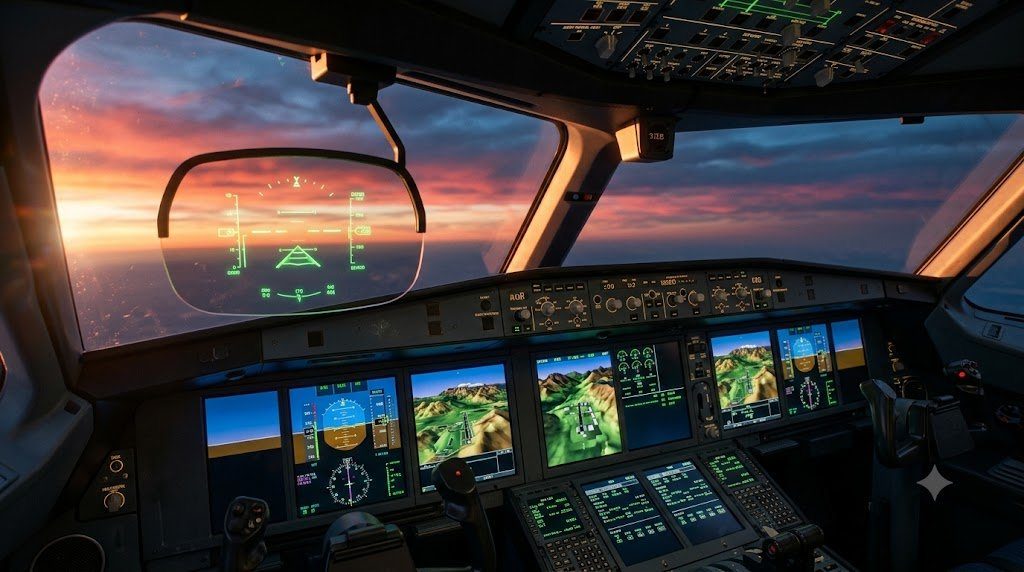
- Cognitive Flight Deck Ergonomics: Large-format glass cockpit Active-Matrix Liquid Crystal Displays (AMLCD) rendering Primary Flight Displays (PFD) and Navigation Displays (ND). Intuitive symbology—such as the conformal Flight Path Vector (FPV) and synthetic vision terrain profiles—minimizes pilot cognitive workload and eliminates spatial disorientation during high-stress IFR flight regimes.
- Rigorous Safety Software Assurance: Universal compliance with RTCA DO-178C (Software Considerations in Airborne Systems) Level A certification, requiring 100% Modified Condition/Decision Coverage (MC/DC) testing, paired with RTCA DO-254 for electronic hardware design assurance.
The avionics backbone represents the cognitive intelligence of modern flight: transmitting critical telemetry across noise-immune ARINC 429 and AFDX networks, tracking atmospheric convective storms and windshear hazards via pulse-Doppler microwave antennas, calculating autonomous vertical collision escape trajectories via TCAS II transponder links, and presenting intuitive flight path vectors on large-format EFIS displays. This unified avionics architecture guarantees unmatched global navigation precision and operational safety.
Future-Proof Avionics: Cybersecurity Assurance (DO-326A) and AI-Driven Flight Automation
As commercial aircraft become nodes in global connected aeronautical telecommunications networks—exchanging real-time flight data with satellite constellations and ground airline operations centers—avionics engineering is aggressively addressing cybersecurity through RTCA DO-326A airworthiness security frameworks. Hardware data diodes, encrypted software loading protocols, and deterministic edge AI microchips ensure that modern flight decks remain impervious to cyber intrusions while paving the way for autonomous single-pilot operations and NextGen trajectory-based flight guidance.