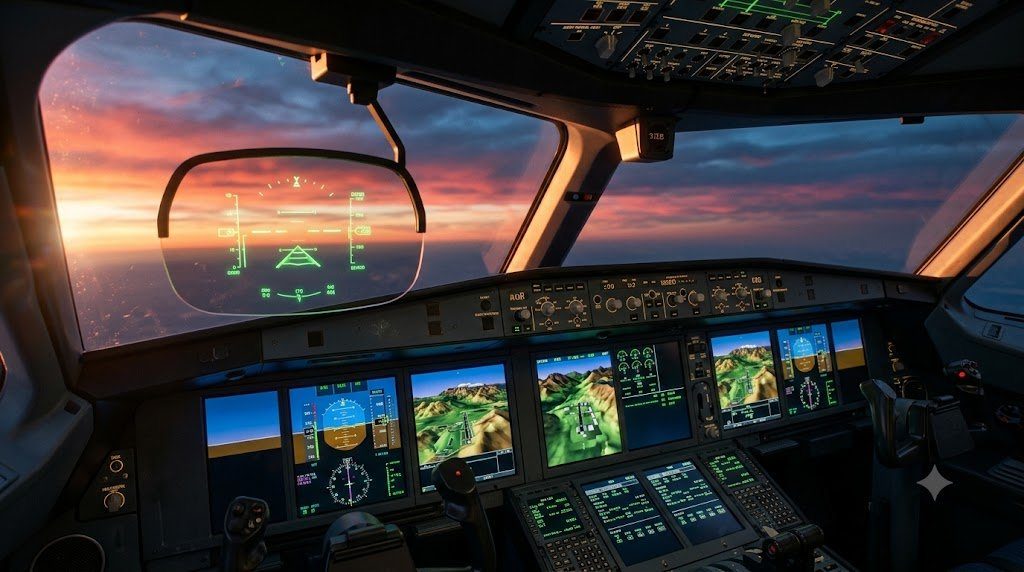
How an Aircraft’s Glass Cockpit Turns Sensor Data into Flight Information

AVIONICS FLIGHT DECK REVIEW / AVIATION TECHNOLOGY From Invisible Measurements to a Clear Flight Picture Discover how aircraft sensors, computers, and electronic displays work together to help pilots understand speed, altitude, attitude, navigation, and aircraft systems. FLIGHT SENSORS AVIONICS COMPUTERS DIGITAL DISPLAYS Step inside the cockpit of a modern aircraft, and you may notice something … Read more

Why Aircraft Wings Flex: How Materials and Design Handle Flight Loads

AEROSPACE ENGINEERING / AIRCRAFT STRUCTURES The Engineering Behind Flexible Aircraft Wings Discover why aircraft wings bend during flight, how structural materials carry enormous forces, and why controlled flexibility is an important part of modern aircraft design. WING FLEX FLIGHT LOADS COMPOSITE MATERIALS Look out of an airplane window during takeoff or while flying through turbulence, … Read more

How Autopilot Works What It Controls and When Pilots Take Over

FLIGHT DECK SYSTEMS · AVIATION TECHNOLOGY Who Is Really Flying When Autopilot Is On? Explore how modern aircraft maintain their course, altitude, and flight path—and why pilots remain essential even when automation is controlling the airplane. FLIGHT CONTROL AUTOMATION PILOT OVERSIGHT During a long commercial flight, passengers may imagine that the pilots spend hours manually … Read more

Turbofan vs Turboprop Engines: Why Different Aircraft Use Different Power Systems

AVIATION ENGINEERING / AIRCRAFT PROPULSION Two Engine Designs. Two Very Different Flying Missions. Explore how turbofan and turboprop engines generate thrust, why their efficiency changes with speed, and how aircraft manufacturers choose the right propulsion system. JET PROPULSION PROPELLER SYSTEMS FLIGHT EFFICIENCY Watch aircraft departing a busy airport, and you may notice two very different … Read more

TCAS II Collision Avoidance: Mode S Interrogation, Tau Closure Calculations and Coordinated Resolution Advisories

In the high-density airspace environments traversed by commercial aviation, mid-air collisions represent catastrophic, zero-survivability events. To provide an autonomous, air-to-air safety net completely independent of ground air traffic control (ATC) radar, international civil aviation mandates the operation of the Traffic Alert and Collision Avoidance System (TCAS II Version 7.1). Interrogating neighboring aircraft transponders at 1,030 … Read more

Automated Airport Baggage Handling: Ultra-High-Frequency RFID, High-Speed Tilt-Tray Sortation and ICS

Behind the passenger terminals of mega-hub international airports lies one of the most sophisticated industrial automation and material-handling networks in the world: the Automated Baggage Handling System (BHS). Handling upwards of 50,000 to over 150,000 pieces of checked luggage daily, a modern BHS spans tens of kilometers of high-speed conveyor belts, automated multi-level explosive detection … Read more

Air Traffic Management: NextGen ADS-B Out Telemetry, Multilateration Radar and Wake Vortex Separation

Managing the safe, expeditious separation of over 100,000 commercial flights traversing global airspace daily is the complex operational domain of Air Traffic Management (ATM). For over six decades, air traffic control relied primarily on ground-based rotating Primary and Secondary Surveillance Radars (PSR/SSR) constrained by slow update rates (typically 4 to 12 seconds per antenna revolution) … Read more

Runway Surface Tribology: Dynamic Friction Coefficients, Hydroplaning Physics and Saw-Cut Grooving

When an airliner weighing upwards of 250 metric tons touches down at landing speeds exceeding 130 to 150 knots (240 to 280 km/h) on a rain-soaked, snow-covered, or rubber-contaminated runway, stopping the aircraft within available runway lengths is an extreme tribological challenge. Tire-to-ground frictional traction dictates the physical stopping distance, directional crosswind controllability, and aerodynamic … Read more

Instrument Landing Systems: Category IIIc Localizer Arrays, Glide Slope Antenna Physics and Multipath Errors

In the physical infrastructure of modern international aerodromes, maintaining continuous high-volume flight operations during adverse meteorological conditions—dense nocturnal radiation fog, blinding winter blizzards, and low cloud ceilings—relies on ground-based precision guidance: the Instrument Landing System (ILS). Standardized globally under ICAO Annex 10, the ILS projects precision radio frequency navigation beams into the airspace, guiding arriving … Read more

Glass Cockpits and Integrated EFIS: Primary Flight Displays, Head-Up Displays and Synthetic Vision Systems

The flight deck environment of commercial transport and advanced military aircraft has migrated completely from the electro-mechanical clutter of legacy analog dial instruments (’round dials’) toward fully integrated Electronic Flight Instrument Systems (EFIS / Glass Cockpits). Presenting dynamic flight symbology across high-resolution active-matrix liquid crystal displays (AMLCD) and organic light-emitting diode (OLED) screens, modern flight … Read more